Help in Morse Code | SOS Signals & Emergency Guide
Immediate Translation | How to Say 'Help' in Morse Code? (. . . . . . - . . . - - . )
In a survival situation, clarity is survival. While the universal distress signal is SOS, knowing how to specifically spell out "HELP" can be crucial if you need to communicate more than just distress. The Morse code for the word "HELP" is composed of four distinct letter signals.
The Morse Code for HELP is:
.... . .-.. .--.
The Literal Translation of H-E-L-P vs. The Universal SOS
There is a critical difference between spelling out the English word "HELP" and using the international standard "SOS." Spelling "HELP" requires the receiver to understand English and decode four separate complex characters. SOS, however, is a "prosign"—a continuous signal recognized globally regardless of language.
| Word | Morse Code Sequence | Audio Rhythm (Phonetic) | Usage Context |
|---|---|---|---|
| HELP | .... . .-.. .--. | Di-di-di-dit Dit Di-dah-di-dit Di-dah-dah-dit | Specific request for assistance; relies on English literacy. |
| SOS | ...---... | Di-di-dit Dah-dah-dah Di-di-dit | Universal Distress Signal. Recognized instantly worldwide. |
Visualizing the Dots and Dashes (Dit and Dah)
Morse code relies on two distinct signal durations: the dot (short) and the dash (long).
- Dot (Dit): A very short signal (1 unit of time).
- Dash (Dah): A long signal (3 units of time).
- Silence: The gap between parts of the same letter is 1 unit; between letters is 3 units; between words is 7 units.
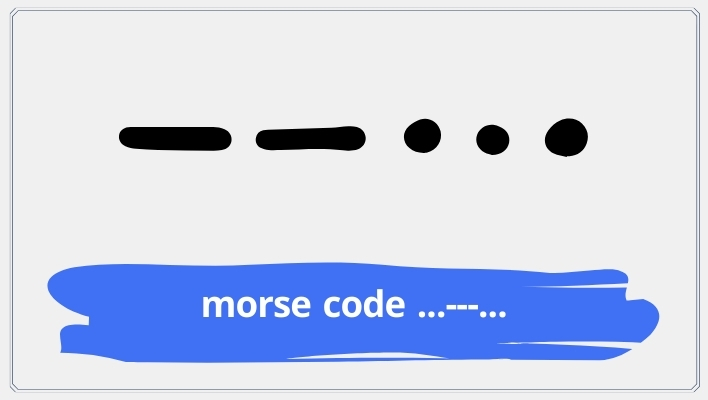
The Standard Distress Signal | Why SOS (... --- ...) is Preferred
If you are in immediate danger, do not spell "HELP." Instead, transmit SOS. It is faster, easier to loop, and unmistakable.
History of the SOS Signal in Maritime Emergencies
The SOS signal was officially adopted by the International Telecommunication Union (ITU) in 1908. Contrary to popular belief, it does not stand for "Save Our Souls" or "Save Our Ship." It was chosen purely for its distinctive rhythm: three dots, three dashes, three dots. It replaced the earlier Marconi signal "CQD" (Come Quick Danger), which was used during the RMS Titanic disaster alongside the newer SOS signal.
Why SOS is Easier to Transmit Under Stress than 'Help'
Under extreme stress or hypothermia, fine motor skills degrade. Tapping out the complex sequence for "HELP" (.... . .-.. .--.) requires precision. The SOS signal (...---...) is rhythmic and repetitive. You can tap it out blindly or flash it with a light without needing to remember complex letter combinations.
Practical Methods to Signal for Help in Survival Situations
You do not need a telegraph key to send Morse code. You can use any device that produces sound or light.
Using a Flashlight or Mirror (Visual Signaling)
Visual signaling is effective for attracting rescue planes or ships. Using a flashlight or a signal mirror:
- 3 Short Flashes: Turn the light on and off quickly (approx. 1 second each).
- 3 Long Flashes: Keep the light on for longer periods (approx. 3 seconds each).
- 3 Short Flashes: Repeat the quick flashes.
- Pause: Wait for a few seconds of darkness before repeating the cycle.
Using a Whistle or Tapping (Audio Signaling)
Sound carries further than voice in dense forests or fog. Use a survival whistle or tap on a pipe:
- Blast 3 times quickly (Short).
- Blast 3 times slowly (Long).
- Blast 3 times quickly (Short).
Timing Your Signal | The 3-Short, 3-Long, 3-Short Rhythm
The rhythm is more important than the exact speed. Ensure the "long" signals are noticeably longer than the "short" ones. The pattern should sound like: beep-beep-beep... BEEEEEP-BEEEEEP-BEEEEEP... beep-beep-beep.
Interactive Morse Code Translator Tool
For practice or translation, various online tools adhere to international standards.
Convert Text to Morse Code Instantly
Tools like Morse Code Translator allow users to type text and instantly see the corresponding dots and dashes. These platforms often include a "Play" button to hear the correct timing.
Play the Audio | Hearing the Difference Between 'Help' and 'SOS'
Hearing the code is the best way to memorize it. "HELP" sounds choppy and complex, whereas "SOS" has a musical, waltz-like rhythm (1-2-3, 1-2-3, 1-2-3) that is designed to cut through static and background noise.
Morse Code in Pop Culture and Gaming
Morse code frequently appears in media as a hidden layer of lore or a gameplay mechanic.
Decoding the 'Help Me' Message in Identity V (Asylum Room)
In the popular asymmetrical horror game Identity V, players have discovered an easter egg in the "White Sand Street Asylum" map. Inside Cell 2, a light fixture blinks a specific pattern. Astute players have decoded this blinking red light as the Morse code for "HELP ME" or "SOS," adding a layer of narrative depth to the asylum's dark history.
References in Movies and Television
From the blinking eyes of a prisoner of war in Vietnam to the dust patterns in Interstellar, Morse code remains a favorite trope for silent communication. Educational channels like RTÉ Kids have also featured segments teaching children how to signal for help, ensuring this vital skill is passed to new generations.
Frequently Asked Questions
What is the Morse code for help me?
The Morse code for "HELP ME" is: .... . .-.. .--. / -- . (Help: .... . .-.. .--. | Me: -- .).
Is SOS Morse code for help?
Technically, SOS is not a word but a "prosign" (procedural signal) used as a universal distress call. While it is interpreted as a request for help, it does not literally spell the word "HELP."
Does SOS stand for "Save Our Souls"?
No. SOS is a "backronym." It was chosen because the sequence (... --- ...) is easy to transmit and recognize, not because it stands for specific words like "Save Our Souls" or "Save Our Ship."
How do you signal SOS with a flashlight?
Flash 3 short times, followed by 3 long flashes, and finally 3 short flashes. Pause for several seconds and repeat the sequence continuously.
What is 3 dots 3 dashes 3 dots?
This sequence (... --- ...) represents SOS, the international Morse code distress signal.
How long is a dot vs a dash?
A dash (dah) is three times as long as a dot (dit). The silence between parts of a letter is equal to one dot, while the silence between letters is equal to three dots.
What is the difference between SOS and Mayday?
SOSis a Morse code distress signal used for visual (light) or telegraphic communication. "Mayday" is a voice distress signal used over radio communications. Both indicate a life-threatening emergency.