Mastering SOS in Morse Code | The Universal Distress Signal Guide
Decoding the SOS Sequence | ··· ——— ···
The SOS signal is the most recognizable distress call in the world. While often associated with maritime history, it remains a critical tool for modern survival. Understanding its structure is essential for anyone venturing into remote areas or engaging in maritime activities.
The Visual Pattern | Three Dots, Three Dashes, Three Dots
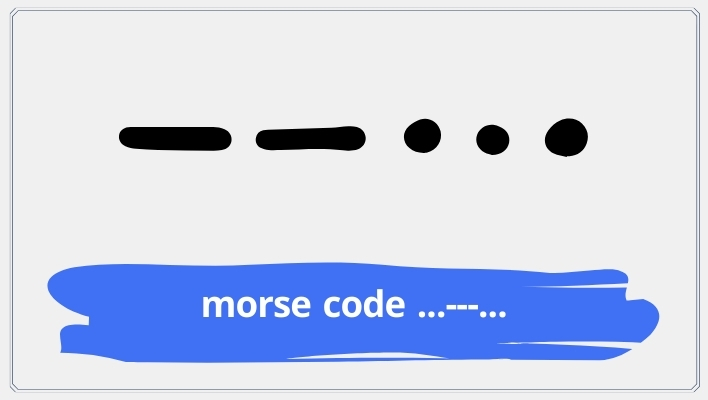
Visually, SOS is represented by a symmetrical pattern that is easy to recognize even by those untrained in Morse code. It consists of three short marks, followed by three long marks, and concluding with three short marks.
- S: ··· (Three Dots)
- O: ——— (Three Dashes)
- S: ··· (Three Dots)
This distinct pattern allows the signal to be identified visually when written in snow, sand, or arranged using rocks on a beach.
The Auditory Rhythm | Short and Long Signal Timing
In Morse code, timing is everything. The auditory transmission relies on the distinction between "dits" (short sounds) and "dahs" (long sounds). To send SOS correctly, you must adhere to standard timing units:
| Signal Type | Duration (Units) | Description |
|---|---|---|
| Dot (Dit) | 1 Unit | A short tap or beep. |
| Dash (Dah) | 3 Units | A long tone, three times the length of a dot. |
| Intra-char Space | 1 Unit | Silence between dots and dashes within the same letter. |
The "Prosign" Distinction | A Continuous Stream vs. Separate Letters
A common misconception is that SOS is sent as three separate letters: S, pause, O, pause, S. In reality, SOS is a procedural signal (or "prosign"), formally written with a bar over the top ($\overline{\text{SOS}}$). This means it is transmitted as one continuous stream of sound without the standard 3-unit silence between letters.
Correct Prosign Timing: ···---··· (Continuous)
Incorrect Letter Timing: ··· (Pause) --- (Pause) ···
Practical Methods to Transmit SOS in Emergencies
Knowing the code is only half the battle; transmitting it effectively using available resources is what saves lives.
Signaling with Light | Using Flashlights or Mirrors (3 Short, 3 Long, 3 Short)
Visual signaling is highly effective at night or over long distances. Using a flashlight or a signal mirror:
- 3 Short Flashes: Rapid bursts of light (approx. 1 second each).
- 3 Long Flashes: Longer beams of light (approx. 3 seconds each).
- 3 Short Flashes: Rapid bursts again.
Ensure the distinction between short and long flashes is obvious to the observer.
Signaling with Sound | Tapping, Whistling, and Banging Walls
If you are trapped in a collapsed building or lost in dense fog, sound is your primary signaling method. You can tap on pipes, blow a survival whistle, or bang on walls.
- Whistle: Three short blasts, three long blasts, three short blasts.
- Tapping: Three quick taps, three slower/louder knocks, three quick taps.
Proper Timing and Pauses Between Repetitions
To ensure the signal is not mistaken for random noise, you must include a distinct pause after completing the full "··· ——— ···" sequence. Standard protocol suggests a silence of several seconds (or roughly 7 timing units) before repeating the SOS pattern. This repetition confirms that the signal is intentional and human-made.
Historical Origins and Adoption of SOS
The SOS signal was not the first distress code, but it became the most enduring due to its simplicity.
Replacement of CQD and Early Maritime Standards
Before SOS, the Marconi Company used CQD ("CQ" for general call, "D" for distress). However, CQD was complex to send and easily misinterpreted in poor static conditions. Other nations used different codes, creating dangerous confusion at sea.
The 1906 Berlin International Radiotelegraph Convention
The need for a universal standard led to the adoption of SOS at the International Radiotelegraph Convention in Berlin in 1906. The agreement was signed by multiple nations to standardize wireless telegraphy. You can learn more about the history of international radio regulations at the official website of the International Telecommunication Union (ITU).
Mythbusting | Does SOS Mean "Save Our Souls" or "Save Our Ship"?
Contrary to popular belief, SOS is not an acronym. Phrases like "Save Our Souls" or "Save Our Ship" are backronyms created later to help people remember the letters. The sequence was chosen solely because it was distinctive, easy to remember, and easy to transmit without error.
Frequently Asked Questions
Common Questions About SOS Morse Code
What does SOS actually stand for?
SOS does not stand for anything. It was selected because the Morse code pattern (··· ——— ···) is simple, unmistakable, and easy to transmit.
How do you write SOS in Morse code?
It is written as three dots, three dashes, and three dots: ··· ——— ···.
Is SOS still used as a distress signal today?
Yes. While digital systems like GMDSS have replaced Morse code for official maritime monitoring, SOS remains a recognized visual and audio distress signal for hikers, pilots, and mariners worldwide as of 2026.
Why are there three dots and three dashes in SOS?
This pattern was chosen for its high contrast. The sharp difference between the shortest signal (dots) and the longest signal (dashes) makes it easy to distinguish from background static or interference.
Is SOS the same in all languages?
Yes. SOS is an international standard. The Morse code sound pattern is universal and does not rely on the alphabet of any specific language.
What replaced SOS as the official maritime distress signal?
The Global Maritime Distress and Safety System (GMDSS) officially replaced Morse code SOS for major maritime safety in 1999. GMDSS uses satellite and digital technology to automate distress alerts.
What is the difference between SOS and Mayday?
SOS is a Morse code signal transmitted via sound (telegraphy, tapping) or light. "Mayday" is a voice distress signal spoken over radio communications. Both indicate a life-threatening emergency.
Was the Titanic the first ship to use SOS?
No. While the Titanic disaster in 1912 made SOS famous, the signal was first used by the steamship Slavonia in 1909. The Titanic's radio operators transmitted both the older CQD signal and the new SOS signal.