what is the meaning of ...---... in morse code
Unlocking the Meaning of ...---... (SOS) Sequence
The sequence ...---... is perhaps the most recognizable pattern in the history of telecommunications. While often dramatized in movies as a desperate cry for help, its technical construction is a masterpiece of simplicity designed for clarity under the worst conditions.
The Universal Distress Signal Explained
Contrary to popular belief, "SOS" is not an acronym. It does not stand for "Save Our Souls," "Save Our Ship," or "Send Out Succour." These are backronyms—phrases invented later to fit the letters.
In reality, the signal is a Procedural Signal (Prosign). It was selected at the International Radiotelegraph Conference in Berlin in 1906 purely because of its distinctive rhythm. In International Morse Code, it is transmitted as a continuous stream of sound or light, without the standard spacing between letters. It is not sent as "S O S" (three separate letters), but rather as one long symbol: SOS.
Audio Representation | Di-di-dit Dah-dah-dah Di-di-dit
To the trained ear, Morse code is a language of rhythm, not just dots and dashes. The audio representation of SOS is distinct because it combines the shortest and longest elements in a symmetrical pattern:
- S (...): Three short "dits" (Di-di-dit)
- O (---): Three long "dahs" (Dah-dah-dah)
- S (...): Three short "dits" (Di-di-dit)
When transmitted as a distress signal, this sequence is looped continuously, creating an unmistakable siren-like rhythm that can cut through static and interference.
Visual Representation | Dot-Dot-Dot Dash-Dash-Dash Dot-Dot-Dot
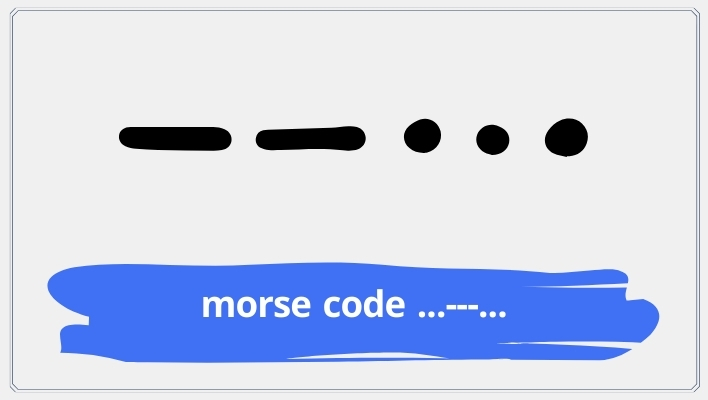
Visually, the signal is represented as:
• • • — — — • • •
This visual simplicity allowed it to be signaled using anything from a flashlight to a mirror, or even by arranging rocks on a beach to be seen from the air.
International Morse Code Basics and Structure
Morse code is a binary system that predates modern computing. It encodes the ISO Basic Latin alphabet, Arabic numerals, and punctuation into standardized sequences of short and long signals.
Dits and Dahs | The Binary Language of Dots and Dashes
The foundation of the code relies on two distinct signal durations:
- Dit (•): A short pulse.
- Dah (—): A long pulse.
Every character is a unique combination of these two sounds. For example, the letter "E" is a single dit (.), while "T" is a single dah (-), making the most common letters in English the shortest to transmit.
Standardized Signal Durations and Timing Rules
To ensure that Morse code is readable globally, the International Telecommunication Union (ITU) established strict timing rules based on the length of a single "dit."
| Element | Duration (Units) | Description |
|---|---|---|
| Dit (Dot) | 1 Unit | The basic unit of time measurement. |
| Dah (Dash) | 3 Units | Three times the length of a dit. |
| Intra-character Space | 1 Unit | Silence between dits and dahs within a single letter. |
| Inter-character Space | 3 Units | Silence between two separate letters. |
| Inter-word Space | 7 Units | Silence between two separate words. |
Encoding the Roman Alphabet and Numerals 0-9
The code covers the 26 letters of the English alphabet and numbers 0-9. Numbers are particularly logical, always consisting of five elements:
- 1: .---- (One dit, four dahs)
- 5: ..... (Five dits)
- 9: ----. (Four dahs, one dit)
- 0: ----- (Five dahs)
Methods of Transmission | Telegraph, Light, and Sound
While originally designed for the electrical telegraph, the versatility of Morse code allows it to be transmitted through almost any medium that can be switched on and off.
Using Flashlights and Mirrors for Visual Signaling
In maritime and survival situations, visual Morse is crucial. An Aldis lamp (signal lamp) is used between ships to send silent messages. For hikers or survivors, a signal mirror can flash sunlight to rescue planes using the SOS pattern. The key is to maintain the distinct timing: a long flash must be clearly three times longer than a short flash.
Radio and Satellite Communication Protocols
In amateur radio (Ham radio), Morse code is known as CW (Continuous Wave). It is highly efficient because it requires very little bandwidth and can be decoded even when the signal is extremely weak, unlike voice transmission. Modern satellites also use simple beacon signals that can be decoded as Morse telemetry.
Tactile Signaling: Tapping and Vibration
Morse can be felt as well as heard. "Tactile Morse" involves tapping a person's hand or using a vibration device. This method is famously used by the deaf-blind community and was historically used by prisoners of war to communicate by tapping on pipes or walls.
Techniques to Learn Morse Code from Memory Experts
Learning Morse code is similar to learning a new language or a musical instrument. It requires repetition and the right strategy.
Visual Mnemonics vs. Auditory Learning
Many beginners try to learn by looking at a chart (Visual). However, experts agree that Auditory Learning is superior. If you memorize the visual dots and dashes, your brain has to translate the sound to an image, then to a letter, which is too slow. You must learn to hear the rhythm (e.g., hearing "dah-dit" and instantly thinking "N").
The Farnsworth Method for Speed Building
The Farnsworth Method is the gold standard for increasing speed. Instead of slowing down the individual dits and dahs, this method sends the characters at a high target speed (e.g., 20 words per minute) but places extra long spaces between the letters.
This prevents the bad habit of counting dits. You hear the character as a complete sound unit, but you have extra time to process it before the next one comes.
Common Pitfalls When Memorizing Dits and Dahs
- Counting Dits: Never count "one, two, three dots." You must recognize the pattern "S" instantly.
- Visual Charts: Avoid charts that draw the letters using dots and dashes (e.g., drawing a 'B' with a line and dots). This creates a mental crutch that slows you down.
- Practicing Sending Before Receiving: Always prioritize listening (receiving) over tapping (sending). Sending is easy; receiving is the skill.
Modern Tools and Translators for Morse Code
Technology has made learning and using Morse code easier than ever. Below are verified, official tools to help you practice and translate.
Web-Based Translators with Audio Playback Features
For a comprehensive learning experience, Morse Code Translator (Text ↔ Morse) offers one of the best online translators. It allows you to customize the frequency, speed, and Farnsworth spacing, making it an excellent training ground.
Using EasyType Features for Faster Input
If you are looking for a user-friendly interface, the BlenderTimer Morse Code Translator includes a feature called "EasyType." This tool is designed to streamline the input process, allowing users to type text and instantly hear the corresponding Morse audio based on real-world recordings.
Mobile Apps for Training Levels and Decoding
For Android users, the app simply titled Morse Code by developer Pavel Holeček is highly rated for its structured learning modules. It guides you through levels, starting with simple letters and advancing to complex sentences. You can download it from the Google Play Store.
History | From CQD to ...---... and Beyond
The evolution of distress signals reflects the history of maritime safety and international cooperation.
The Myth of 'Save Our Souls' vs. Technical Simplicity
As mentioned, SOS is not an acronym. Before SOS, the British used CQD ("CQ" for "All Stations" and "D" for "Distress"). However, CQD was complex to send and could be confused with other signals. The German government suggested the ...---... sequence because it was impossible to misinterpret, even by an unskilled operator. It was adopted internationally in 1908.
The Role of Morse Code in Maritime History (Titanic)
The sinking of the RMS Titanic in 1912 is the most famous use of Morse code in history. The Titanic's radio operators, Jack Phillips and Harold Bride, initially sent the traditional British signal CQD. Later in the night, at the suggestion of Bride, Phillips also began transmitting the new international standard, SOS. The tragedy cemented SOS as the primary distress signal for decades to come.
Frequently Asked Questions
What does ... --- ... mean in Morse code?
The sequence ... --- ... represents the universal distress signal SOS. It consists of three dots (S), three dashes (O), and three dots (S). It is a procedural signal used to request immediate emergency assistance.
Is Morse code international and universal?
Yes, International Morse Code is the global standard defined by the ITU. While some languages with non-Latin characters (like Russian or Arabic) have their own extensions, the core alphabet and the SOS signal are recognized worldwide.
Why was SOS chosen as the distress signal?
SOS was chosen for its simplicity and distinctiveness. The pattern of three short, three long, and three short signals is easy to remember, easy to transmit, and difficult to confuse with other messages, even through heavy static.
How do I type letters and numbers into a Morse translator?
In most tools like Morse Code World, you simply type standard text (e.g., "Hello") into the input box, and the tool automatically converts it to dots and dashes. Conversely, you can type periods (.) and hyphens (-) to decode Morse back into text.
Can I learn Morse code in 15 minutes?
You can learn the basic concept and perhaps memorize the SOS signal and a few vowels in 15 minutes. However, achieving proficiency to send and receive full sentences requires weeks of consistent practice, ideally using the Farnsworth method.
What is the Morse code for "I Love You"?
The phrase "I Love You" is coded as .. / .-.. --- ...- . / -.-- --- ..-. It is one of the most popular phrases translated by beginners and is often used in jewelry and art.
Is Morse code still used today?
Yes, while it has been replaced by digital systems (like GMDSS) for official maritime distress calls, it is still widely used by amateur radio operators, in aviation navigation aids (VOR), and as a reliable backup method of communication in emergencies.