What Is Morse Code? Definition, History & How to Read It
Unlocking the Code | What Exactly Is Morse Code/Telecommunications Method? (Definition & Basics)
Morse code is a telecommunications method that encodes text characters as standardized sequences of two different signal durations, known as dots (short signals) and dashes (long signals). Originally designed for the electrical telegraph in the mid-19th century, this system transformed global communication by allowing messages to travel faster than physical mail.
At its most fundamental level, Morse code is a binary system of rhythm. It translates the alphabet, numerals, and punctuation marks into a series of "on" and "off" signals. These signals can be transmitted via sound (beeps), light (flashes), or radio waves (pulses), making it one of the most versatile communication methods in history.
Defining the System: Standardized Sequences of Signal Durations
The efficiency of Morse code relies on a strict set of timing rules. The entire system is built around the duration of the "dot" (or "dit"). This single unit of time serves as the reference point for all other elements in the code. By standardizing these durations, operators across the world—regardless of language—can interpret the rhythmic patterns as specific characters.
The International Telecommunication Union (ITU) establishes the global standards for Morse code to ensure that a distress signal sent from a ship in the Atlantic is perfectly understood by a rescue station in Europe.
The Core Components | Dits, Dahs, and Spacing Rules
To master Morse code, one must understand its three primary building blocks:
- The Dot (Dit): The basic unit of time. It represents a short signal (1 unit).
- The Dash (Dah): A long signal. Its duration is exactly three times that of a dot (3 units).
- The Space: Silence is as important as the sound. Spacing distinguishes letters and words from one another.
The binary nature of the code allows it to represent complex information using simple elements. For example, the letter "E" is represented by a single dot (.), while "T" is a single dash (-). More frequent letters in the English language were assigned shorter sequences to speed up transmission.
Transmission Mediums | Telegraph, Radio, Satellite, and Light
While originally sent over telegraph wires, Morse code evolved to utilize various physical mediums. In the maritime world, ships use signal lamps to flash Morse code messages to nearby vessels, a method that requires no radio equipment and maintains radio silence. In aviation and amateur radio, the code is transmitted via Continuous Wave (CW) radio signals.
The timing rules are mathematically precise to prevent confusion:
| Element | Duration (Units) | Description |
|---|---|---|
| Dot (Dit) | 1 Unit | The basic reference unit. |
| Dash (Dah) | 3 Units | Three times the length of a dot. |
| Intra-character Space | 1 Unit | Silence between dots and dashes within the same letter. |
| Inter-character Space | 3 Units | Silence between two separate letters. |
| Word Space | 7 Units | Silence between two separate words. |
The History of Morse Code | From 1836 to the Digital Age
The story of Morse code begins in the early 19th century, a time when long-distance communication was limited to the speed of a horse or a ship. The invention of the electric telegraph changed the world forever, shrinking the globe and allowing information to travel almost instantaneously.
Samuel Morse and the Invention of 1836
In 1836, Samuel Morse, an American scientist and artist, along with his colleagues Alfred Vail and Joseph Henry, developed the electrical telegraph system. While Morse is often credited with the invention, Alfred Vail played a crucial role in developing the code itself, particularly the concept of assigning shorter sequences to more common letters.
On May 24, 1844, Samuel Morse sent the first official telegraph message from Washington, D.C., to Baltimore. The message, "What hath God wrought?", marked the beginning of the telecommunications era.
Evolution of the Code | American vs. International Standards
The original code developed by Morse and Vail, known as American Morse Code, was used extensively in the United States. However, it had spacing irregularities that made it difficult for non-English speakers and automated equipment to interpret. As telegraph lines crossed borders and oceans, a standardized system was needed.
This led to the creation of International Morse Code (also known as Continental Morse Code). This modern standard eliminated the variable spacing of the American version, making it suitable for global maritime and aviation communication. Today, International Morse Code is the version used worldwide.
How to Read and Translate Morse Code (Chart & Mechanics)
Reading Morse code is a skill that transitions from visual decoding to auditory recognition. While beginners often use charts to translate dots and dashes visually, experts listen to the rhythm of the sounds, treating them like a new language rather than a code to be deciphered.
Visualizing the Alphabet: Letters, Numerals, and Punctuation
The International Morse Code assigns a unique sequence to each letter of the alphabet and the numbers 0-9. Below is a breakdown of some common characters:
- A: .- (Dit-Dah)
- B: -... (Dah-Dit-Dit-Dit)
- C: -.-. (Dah-Dit-Dah-Dit)
- S: ... (Dit-Dit-Dit)
- O: --- (Dah-Dah-Dah)
- 1: .---- (Dit-Dah-Dah-Dah-Dah)
- 5: ..... (Dit-Dit-Dit-Dit-Dit)
- 0: ----- (Dah-Dah-Dah-Dah-Dah)
Punctuation and procedural signals (prosigns) are also defined. For example, the "End of Work" signal is often sent as "...-.-".
Using a Morse Code Translator | Inputs and Outputs
In the digital age, you do not need a telegraph key to generate Morse code. Modern tools allow users to type text and instantly convert it into audio beeps or light flashes. Websites like Morse Code World provide interactive translators where you can type a message and hear it played back at various speeds.
When using these translators, if you input a character that does not exist in the standard Morse alphabet (such as certain special symbols), the output will often display a # symbol to indicate it is untranslatable. These tools are excellent for learners to practice "copying" (listening and writing down) code at slower speeds before speeding up.
Practical Uses | Why Morse Code Is Still Relevant Today
Despite the advent of the internet and satellite phones, Morse code remains a critical backup system. Its simplicity allows it to be transmitted over extremely low-bandwidth signals that voice or digital data cannot penetrate.
Military, Aviation, and Naval Communication
The military has historically relied on Morse code for secure and reliable communication. While it is no longer the primary method, the U.S. Navy and other maritime forces still train sailors to use signal lamps for ship-to-ship communication during periods of radio silence. In aviation, pilots use Morse code to identify navigational aids. VOR (VHF Omnidirectional Range) stations transmit their three-letter identification codes in Morse, allowing pilots to verify they are tuned to the correct beacon.
Amateur Radio and Emergency Signaling (SOS)
The most vibrant community keeping Morse code alive is Amateur Radio (Ham Radio). Organizations like the ARRL (American Radio Relay League) promote the use of CW (Continuous Wave) transmission. Many operators prefer Morse code because it requires very little power and can travel vast distances even in poor atmospheric conditions.
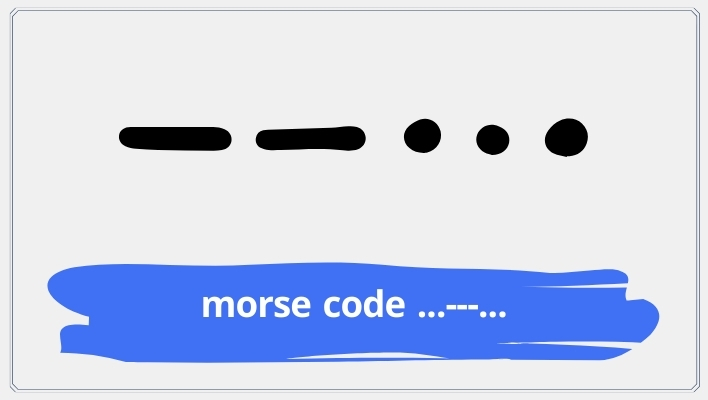
The most famous Morse code signal is the universal distress call: SOS. Represented as ... --- ... (three dots, three dashes, three dots), it is recognized globally as a call for help. It was chosen not for any acronym (like "Save Our Souls"), but because the sequence is distinct and easy to transmit.
Frequently Asked Questions
Is Morse code still used today?
Yes, Morse code is still actively used in specific sectors. In aviation, pilots listen to Morse code identifiers to confirm they are tuned to the correct VOR or NDB navigational stations. It is also extremely popular among amateur radio operators (hams) who use it for long-distance communication (DXing) and contests. Furthermore, it remains a recognized backup signaling method for the military and maritime safety.
Is Morse code hard to learn?
Learning Morse code is a skill similar to learning a musical instrument or a new language. While memorizing the visual dots and dashes can be done quickly, achieving proficiency in listening requires practice. The most effective method is to learn the sound of each letter as a complete rhythmic unit, rather than counting individual dits and dahs.
Who invented Morse code?
Samuel Morse, an American inventor, is credited with inventing the code in 1836 to work with his electrical telegraph. However, his assistant Alfred Vail contributed significantly to the code's design, specifically the idea of assigning shorter codes to the most frequently used letters (like 'E' and 'T').
What do the dots and dashes mean in Morse code?
The dots and dashes are simply representations of time. A "dot" is a signal that lasts for one unit of time. A "dash" is a signal that lasts for three units of time. By combining these short and long sounds, every character in the alphabet can be uniquely identified.
Is Morse code considered a language?
No, Morse code is not a language in itself. It is an encoding system (or alphabet) used to transmit the characters of an existing language, such as English or Russian. Unlike a language, which has its own grammar and vocabulary, Morse code is simply a method of representing written text through sound or light.
What does SOS stand for?
Contrary to popular belief, SOS does not stand for "Save Our Souls" or "Save Our Ship." The signal ... --- ... was chosen because it is a distinctive sequence that is easy to remember and transmit clearly, even in poor conditions. It has no literal meaning other than being a universal distress signal.
How do you say 'I love you' in Morse code?
To transmit the phrase "I love you," you would send the following sequence:
.. (I)
.-.. --- ...- . (LOVE)
-.-- --- ..- (YOU)