What Is the End Signal in Morse Code?
What Is the End Signal in Morse Code? The Definitive Guide to Prosigns <AR>, <SK>, and <VA>
Morse code is more than just a series of dots and dashes representing the alphabet; it is a structured language with its own punctuation and control commands. Among the most critical of these are "prosigns" (procedural signals)—special combinations of letters sent as a single character to control the flow of communication. Understanding the "End Signal" is vital for anyone looking to master this timeless mode of transmission.
This guide provides a technical breakdown of the end signals <AR>, <SK>, and <VA>, explaining their specific sequences, timing rules, and operational differences as defined by international standards.
Understanding Procedural Signals (Prosigns) in Morse Code
To the untrained ear, Morse code may sound like a continuous stream of beeps. However, skilled operators use specific signals to manage the conversation, much like a pilot uses "Over" and "Out" in voice radio. These are called prosigns.
Defining Prosigns: Running Letters Together Without Spacing
A prosign is typically represented in text by two letters with a bar over them (e.g., AR). In transmission, these two letters are "run together."
In standard Morse code, there is usually a gap of three units (the length of a dash) between letters. However, for a prosign, the operator removes this inter-letter gap, sending the elements of both letters as one continuous rhythmic sound. This creates a unique sound distinct from the individual letters sent separately.
Why Prosigns are Critical for Efficient Communication
Prosigns serve as the metadata of a Morse transmission. They tell the receiving station what is happening with the message structure. Without them, an operator wouldn't know if a message was finished, if a pause was temporary, or if the station was shutting down for the night. They eliminate ambiguity and ensure that messages are received exactly as intended.
The Primary End of Message Signal: <AR>
The most common "end" signal you will encounter is the End of Message prosign, written as <AR> or AR.
The Specific Sequence | Di-dah-di-dah-di (.-.-.)
The <AR> prosign is formed by combining the letter 'A' (.-) and 'R' (.-.) without the standard spacing between them.
- Sequence: Dot-Dash-Dot-Dash-Dot
- Visual:
.-.-. - Sound: Di-dah-di-dah-di
Usage Context | Signifying the End of a Single Message or Telegram
The <AR> signal indicates that a specific message or telegram has concluded, but the transmission between stations is not necessarily over. It effectively means, "I have finished this specific message, but I am still here and may send more."
In formal traffic handling (such as in the National Traffic System or maritime communications), <AR> is sent immediately after the signature or the last word of the text. It separates one telegram from the next or indicates to the receiving operator that they can now acknowledge receipt.
The End of Transmission Signal | <SK> or <VA>
When an operator is completely finished and intends to close the connection, they use a different signal. This is known as the End of Work or End of Transmission signal.
The Sequence | Di-di-di-dah-di-dah (...-.-)
This signal is widely referred to as <SK>, though it is arguably more accurate to call it <VA> based on the sound. Both combinations produce the exact same rhythmic sequence when run together.
- Sequence: Dot-Dot-Dot-Dash-Dot-Dash
- Visual:
...-.- - Sound: Di-di-di-dah-di-dah
Whether you visualize it as 'S' (...) plus 'K' (-.-) or 'V' (...-) plus 'A' (.-), the resulting pattern is identical.
Distinction Between End of Message (AR) and End of Work (SK)
The difference between these two signals is a frequent source of confusion for beginners. The table below clarifies their distinct roles:
| Prosign | Sequence | Meaning | Voice Equivalent |
|---|---|---|---|
| <AR> | .-.-. | End of Message | "Over" (I am done speaking for now, back to you) |
| <SK> | ...-.- | End of Transmission | "Out" (I am hanging up/turning off the radio) |
The Meaning of 'Silent Key' in Amateur Radio
The prosign <SK> has taken on a poignant meaning in the amateur radio community. Because it signifies the final end of a transmission, the term "Silent Key" is used to refer to a radio operator who has passed away. It is a respectful way to say that their key is silent forever.
For more on amateur radio traditions and operating procedures, you can visit the American Radio Relay League (ARRL).
Other Essential Control Signals and Abbreviations
While <AR> and <SK> handle the endings, other prosigns manage the flow of the conversation.
<KA>: The Starting Signal (-.-.-)
Also known as <CT>, this signal is used to get attention or indicate the start of a transmission. It is formed by running 'K' and 'A' together.
<KN> vs. <K>: Inviting Specific Stations to Transmit (-.--.)
The letter K (-.-) is the standard invitation to transmit, meaning "Over" or "Anyone can reply."
The prosign <KN> (-.--.), however, is more specific. It means "Over to you only." It is used when you are in contact with a specific station and do not want other stations to break in.
<BT>: Indicating a Break or New Paragraph (-...-)
The <BT> prosign (Dash-dot-dot-dot-dash) acts as a separator. It is used to create a break between the preamble and the text of a message, or to signify a new paragraph within a long text. In casual conversation (ragchewing), it is often used as a pause for thought, similar to saying "um" or "err."
<SN> or <VE>: Signifying 'Understood' (...-.)
This signal indicates that a message has been fully understood and verified. It is less common in casual chat but vital in formal message handling.
Morse Code Timing Rules and Spacing
To send these signals correctly, one must adhere to the precise timing rules set by the International Telecommunication Union (ITU).
Distinguishing Dot (1 Unit) and Dash (3 Units) Durations
The fundamental unit of time in Morse code is the dot duration.
- Dot (Dit): 1 unit of time.
- Dash (Dah): 3 units of time (three times the length of a dot).
Rules for Spacing Between Elements, Letters, and Words
Proper spacing is what makes the code readable. Without it, a stream of dots and dashes is indecipherable.
- Intra-character space: The silence between dits and dahs within a single letter is 1 unit.
- Inter-character space: The silence between two separate letters is 3 units. (Note: This is the space that is removed when forming a prosign).
- Word space: The silence between two words is 7 units.
Frequently Asked Questions
What is the difference between AR and SK in Morse code?
<AR> (.-.-.) stands for "End of Message" and indicates that a specific message is complete, but the connection remains open for further traffic. <SK> (...-.-) stands for "End of Work" or "End of Transmission" and indicates that the operator is signing off completely and closing the connection.
How do you know when a letter or word ends in Morse code?
You identify the end of a letter or word by listening to the silence (spacing). A short silence of 3 units indicates the end of a letter. A longer silence of 7 units indicates the end of a word. Prosigns are unique because they combine two letters with only a 1-unit space between their elements, effectively merging them into a new, longer character.
What does the prosign KN mean?
The prosign <KN> (-.--.) is an invitation for a specific station to transmit. It tells all other listening stations to wait and not interrupt the current contact. It is strictly "Over to you," as opposed to the general "K" which means "Over to anyone."
Is SOS an end signal in Morse code?
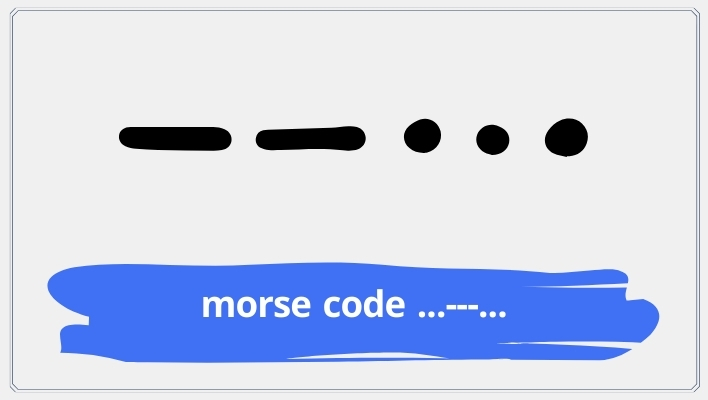
No, SOS (...---...) is not an end signal; it is a distress signal. Like <AR> and <SK>, SOS is a prosign, meaning it is sent as one continuous stream of sound without letter spacing. It is used solely to signal an emergency and request immediate assistance.
What is the Morse code for "Goodbye"?
While there is no single prosign for "goodbye," operators typically use the abbreviation 73 (meaning "Best Regards") followed by the prosign <SK> (End of Transmission). In casual conversation, the abbreviation GB (Good Bye) may also be used.
What does 73 mean in Morse code?
73 is a standard abbreviation meaning "Best Regards." It is widely used in amateur radio to politely end a conversation before sending the final <SK> signal.