Morse Code Letters | Complete A-Z Chart & Reference Guide (2026)
Understanding the International Morse Code System Basics
What is the ITU International Morse Code Standard?
The global standard for Morse code is defined by the International Telecommunication Union (ITU). Specifically, the document Recommendation ITU-R M.1677-1 serves as the definitive reference for the International Morse Code. As of February 8, 2026, this standard remains the universal protocol used by aviation, amateur radio operators, and maritime signaling worldwide.
Unlike the original American Morse Code used on landlines in the 19th century, the International standard (also known as Continental Code) was designed to be distinct and rhythmically consistent for radio transmission. It ensures that a message sent from a ship in the Atlantic can be perfectly understood by a receiving station in the Pacific, regardless of language barriers.
The Fundamental Signals | Dits (Dots) vs. Dahs (Dashes)
Morse code is a binary system composed of two distinct signal durations:
- Dit (Dot): A short signal. It is the basic unit of time measurement in Morse code. Visually represented as a dot (.).
- Dah (Dash): A long signal. It is defined as being three times the length of a dit. Visually represented as a dash (-).
Every character in the alphabet is constructed from a unique sequence of these two sounds. The contrast between the short "di" and the long "dah" creates the rhythm necessary for the human ear to decode the message.
How Timing and Rhythm Define the Code
The readability of Morse code depends entirely on precise timing. Without adherence to these time intervals, a stream of signals becomes indecipherable noise. The ITU specifies the following relative timing rules based on the duration of one "dit":
| Element | Duration (Units) | Description |
|---|---|---|
| Dit | 1 Unit | The reference base unit. |
| Dah | 3 Units | Three times the length of a dit. |
| Intra-character Space | 1 Unit | The silence between dits and dahs within a single letter. |
| Inter-character Space | 3 Units | The silence between two separate letters. |
| Word Space | 7 Units | The silence between two separate words. |
Complete Morse Code Letters Reference Chart (A-Z)
Visual Breakdown of Latin Letters A to Z
Below is the standard alphabet used in International Morse Code. Beginners should focus on the sound (rhythm) rather than just the visual dots and dashes.
| Letter | Code | Letter | Code |
|---|---|---|---|
| A | .- | N | -. |
| B | -... | O | --- |
| C | -.-. | P | .--. |
| D | -.. | Q | --.- |
| E | . | R | .-. |
| F | ..-. | S | ... |
| G | --. | T | - |
| H | .... | U | ..- |
| I | .. | V | ...- |
| J | .--- | W | .-- |
| K | -.- | X | -..- |
| L | .-.. | Y | -.-- |
| M | -- | Z | --.. |
The Most Frequent Letters | E and T
Morse code was designed for efficiency. Samuel Morse and Alfred Vail analyzed the frequency of letters in the English language (often by counting letters in a printer's type case) to assign the shortest codes to the most common letters.
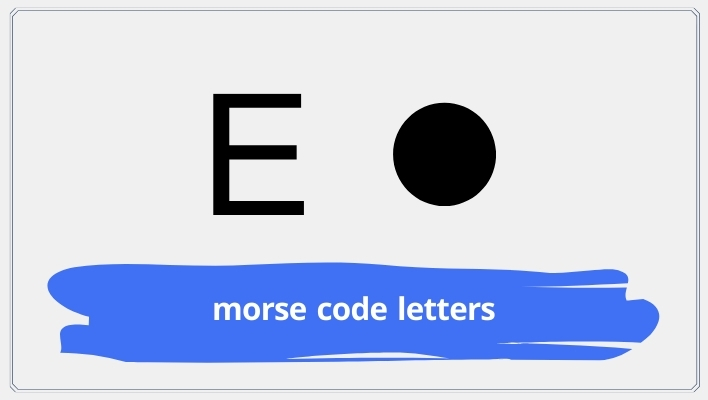
- E (.): The most common letter in English is represented by a single dot.
- T (-): The second most common letter is represented by a single dash.
This design reduces the total transmission time for average sentences, a principle similar to modern data compression.
Handling Accented Letters (e.g., É) in International Code
While standard English Morse code covers A-Z, the ITU International standard includes provisions for accented characters used in other languages. The most universally recognized accented letter in the ITU recommendation is:
- É (E with acute accent): ..-..
Other accented letters (like Ä, Ö, Ü) exist in national variations but are less commonly used in standard international communication unless agreed upon by operators.
Morse Code Numbers and Numerals (0-9)
Standard Long-Form Numerals
Standard numerals in Morse code are very methodical. Each number consists of exactly five elements (a combination of dots and dashes). This regularity makes them distinct from letters.
| Number | Code | Pattern Logic |
|---|---|---|
| 0 | ----- | Five dashes |
| 1 | .---- | One dot, four dashes |
| 2 | ..--- | Two dots, three dashes |
| 3 | ...-- | Three dots, two dashes |
| 4 | ....- | Four dots, one dash |
| 5 | ..... | Five dots |
| 6 | -.... | One dash, four dots |
| 7 | --... | Two dashes, three dots |
| 8 | ---.. | Three dashes, two dots |
| 9 | ----. | Four dashes, one dot |
Abbreviated 'Cut Numbers' for High-Speed Transmission
In competitive radio contesting or high-speed telegraphy, sending five signals for every number is inefficient. Operators use "Cut Numbers," where standard numerals are replaced by shorter letters that resemble the code. These are strictly for context-specific situations (like sending a signal report) and are not used in formal official text.
| Number | Standard Code | Cut Abbreviation | Cut Code |
|---|---|---|---|
| 0 | ----- | T | - |
| 1 | .---- | A | .- |
| 5 | ..... | E | . |
| 9 | ----. | N | -. |
For example, a signal report of "599" is often transmitted as "5NN" to save time.
Essential Punctuation and Special Prosigns
Common Punctuation: Periods, Commas, and Question Marks
Punctuation marks generally consist of six elements, making them longer and distinct from letters and numbers.
- Period (.): .-.-.- (AAA)
- Comma (,): --..-- (MIM)
- Question Mark (?): ..--.. (IMI)
- Slash (/): -..-. (DN)
Procedural Signals (Prosigns) | SOS, AR, and SK
Prosigns are special symbols that convey procedural instructions. They are sent as if they were a single character, with no inter-character spacing between the letters that represent them.
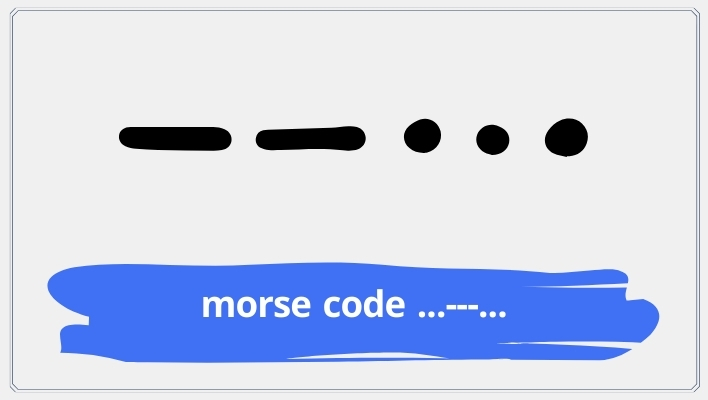
- SOS: ...---... (Universal Distress Signal. Sent as one continuous stream, not three separate letters).
- AR: .-.-. (End of Message. Indicates "I have finished my transmission").
- SK: ...-.- (End of Work. Indicates "I am signing off and closing the station").
- BT: -...- (Break / Separator. Used to separate sections of text).
Strategies to Memorize Morse Code Letters Fast
Visual Mnemonics vs. Audio Rhythm Learning
While visual charts are helpful for reference, the American Radio Relay League (ARRL) and other experts recommend learning by sound (audio rhythm) rather than visual memorization. Counting dots and dashes mentally slows down decoding. Instead, associate the letter "A" with the sound "di-DAH" rather than the image ".-".
Learning by Grouping: Alphabetical vs. Code Order
Learning A-Z alphabetically is often inefficient because the codes vary wildly in complexity. A better approach is "Code Order" or grouping by similarity:
- All Dots: E (.), I (..), S (...), H (....), 5 (.....)
- All Dashes: T (-), M (--), O (---), 0 (-----)
- Opposites: A (.-) vs N (-.); D (-..) vs U (..-); G (--.) vs W (.--)
Using Dichotomic Search Trees for Visualization
A dichotomic search tree is a binary branching diagram. You start at a central point. Moving left represents a "dot" and moving right represents a "dash." This allows you to trace the path to a letter visually. For example, moving left (dot) then right (dash) lands you on "A". This is excellent for decoding slow signals visually but should be discarded for high-speed audio copying.
Technical Rules for Spacing and Transmission
Intra-character Spacing (Between Dots and Dashes)
The silence inside a letter is just as important as the noise. Between the dot and the dash of the letter "A", there must be a silence equal to one dot length. If this silence is too long, the receiver might interpret it as two separate letters (E and T).
Inter-character and Word Spacing Rules
Proper spacing prevents "thequickbrownfox" syndrome. The standard rule is:
- Between Letters: 3 units of silence. This signals that one letter has ended and the next is beginning.
- Between Words: 7 units of silence. This provides a clear audible gap, allowing the listener to separate words in their mind or on paper.
Frequently Asked Questions
How long does it take to learn Morse code letters?
With consistent daily practice of 15-30 minutes, most people can memorize the basic alphabet (A-Z) and numbers (0-9) in about two weeks. Achieving a proficiency of 5-10 words per minute (WPM) typically takes 1 to 2 months of audio training.
What are the hardest letters to learn in Morse code?
Letters with mixed and longer sequences are often the most difficult. Q (--.-), Y (-.--), X (-..-), and J (.---) are frequently cited as challenging because they lack the simple symmetry of letters like E, T, or M.
Is Morse code universal for all languages?
The International Morse Code is based on the Latin alphabet and is the global standard. However, languages that use non-Latin scripts (like Russian, Greek, or Arabic) have their own Morse code extensions that map their specific characters to dot-dash sequences, though they often map similar-sounding letters to the International codes.
How do you signal 'SOS' correctly?
SOSshould be signaled as a continuous stream of sound: ...---... (three dots, three dashes, three dots). Do not pause between the letters. It is a prosign, meaning it is treated as one unique character rather than three separate letters.
Can you type Morse code on a regular keyboard?
You cannot "type" Morse code signals (audio) directly with a standard keyboard without software. However, you can type the visual representation using the period (.) and hyphen (-) keys. There are also "Morse Code Keyboard" apps available for smartphones that allow you to input text by tapping dots and dashes.
Is Morse code still used today?
Yes, Morse code is still actively used, primarily by amateur radio operators (hams) for long-distance communication using low power. It is also used in aviation and maritime navigation for identifying navigational aids (like VORs and NDBs), and remains a backup communication method for military and emergency signaling when complex digital systems fail.
Who invented Morse code?
Morse code was co-developed in the 1830s and 1840s by Samuel Morse and Alfred Vail. While Samuel Morse conceived the telegraph system, Alfred Vail is credited with developing the practical code that assigns shorter sequences (like a single dot for 'E') to the most frequently used letters.