How to Read Morse Code | The Ultimate Guide to Mastering Dots, Dashes, and Timing
Understanding the Fundamentals | Dits, Dahs, and Sound Patterns
Mastering Morse code is less about memorizing a static chart and more about learning a new language of rhythm and timing. At its core, Morse code is a binary system used to transmit information through on-off signals. These signals are standardized by the International Telecommunication Union (ITU) to ensure that a message sent from a ship in the Atlantic can be perfectly understood by a radio operator in Japan.
The fundamental concept relies on a precise unit of time. Every signal, silence, and space is measured relative to the duration of a single "dot." This mathematical precision allows the human brain to distinguish between a random noise and a structured letter. Whether you are decoding a flashing light signal or a high-pitched audio tone, the ability to process these ratios in real-time is what separates a beginner from a master.
Proficiency requires moving beyond visual counting. Instead of thinking "dot-dot-dash," an expert hears the rhythmic sound "di-di-dah" and instantly recognizes the letter "U." This transition from analytical counting to auditory reflex is achieved through techniques like Farnsworth spacing, which increases the silence between letters to give your brain time to process without slowing down the character speed itself.
The Core Components | Dits and Dahs Explained
Morse code is built upon two distinct signal durations and three distinct silence durations. Understanding the physical makeup of these signals is the first step to reading code effectively.
Visual Representation vs. Auditory Recognition
While Morse code is often depicted visually as dots (.) and dashes (-), it was originally designed as an auditory medium. In written form, a dot looks like a period, and a dash looks like a hyphen. However, relying solely on visual charts can hinder your speed. In practice, you should associate the visual symbol immediately with its sound.
- Visual: . - (A)
- Auditory: di-dah (A)
The 'Dit' (Dot): The Basic Unit of Time
The "dit" (or dot) is the fundamental unit of measurement in Morse code. It represents the shortest signal duration. In mathematical terms, the length of a dit is equal to 1 unit of time. All other elements—dashes and spaces—are calculated as multiples of this single unit.
The 'Dah' (Dash) | Three Times the Length of a Dit
The "dah" (or dash) is the longer signal. By international standard, a dah must be exactly three times the duration of a dit. If a dit lasts for 0.1 seconds, a dah must last for 0.3 seconds. This 1:3 ratio is critical; if the dash is too short, it may be confused for a dot, and if it is too long, it breaks the rhythm of the character.
The Mathematical Rules of Morse Timing and Spacing
Silence is just as important as the signal itself. Without standardized spacing, a stream of dots and dashes would be an unintelligible continuous noise. The ITU specifies three types of spacing based on the 1-unit dit.
| Component | Duration (Units) | Description |
|---|---|---|
| Dit (Dot) | 1 Unit | The basic signal. |
| Dah (Dash) | 3 Units | The long signal. |
| Intra-Character Space | 1 Unit | Silence between dits and dahs within a single letter. |
| Inter-Letter Space | 3 Units | Silence between two separate letters. |
| Inter-Word Space | 7 Units | Silence between two separate words. |
Intra-Character Spacing | The 1-Unit Silence Rule
Inside a single letter, the elements are tightly packed. For example, the letter "S" consists of three dots (...). The silence between the first and second dot, and the second and third dot, is exactly 1 unit (the length of a dot). This tight spacing signals to the receiver that these sounds belong to the same character.
Inter-Letter Spacing | The 3-Unit Silence Rule
When one letter ends and the next begins, the silence is lengthened to 3 units (the length of a dash). This clear pause allows the listener to mentally "close" the previous letter and prepare for the next one.
Inter-Word Spacing | The 7-Unit Silence Rule
To separate words, the silence is extended to 7 units. This is the longest standard pause in Morse code transmission and indicates the completion of a word, similar to a space bar on a keyboard.
Deciphering the International Morse Code Alphabet
Learning the alphabet is best done by grouping letters by their composition or frequency rather than strictly A-Z.
Common Letters and Code Order (E, T, A, N)
The code was designed so that the most frequently used letters in the English language have the shortest codes. This efficiency increases transmission speed.
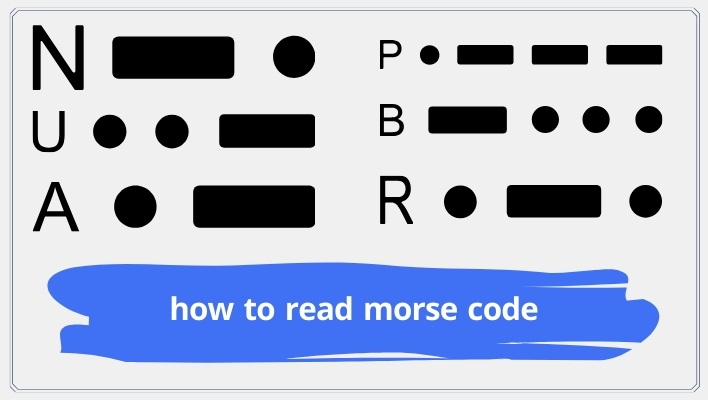
- E: . (1 dit) — The most common letter.
- T: - (1 dah) — The second most common letter.
- A: .- (di-dah)
- N: -. (dah-dit)
The Full Alphabet Breakdown (A-Z)
Below is the standard International Morse Code alphabet. Practice reading these not as visual dots and dashes, but as rhythmic patterns.
- A: .-
- B: -...
- C: -.-.
- D: -..
- E: .
- F: ..-.
- G: --.
- H: ....
- I: ..
- J: .---
- K: -.-
- L: .-..
- M: --
- N: -.
- O: ---
- P: .--.
- Q: --.-
- R: .-.
- S: ...
- T: -
- U: ..-
- V: ...-
- W: .--
- X: -..-
- Y: -.--
- Z: --..
Numbers (0-9) and Standard Punctuation
Numbers in Morse code always consist of five elements (a mix of dots and dashes).
- 0: -----
- 1: .----
- 2: ..---
- 3: ...--
- 4: ....-
- 5: .....
- 6: -....
- 7: --...
- 8: ---..
- 9: ----.
Strategic Methods to Read and Learn Morse Code
The 'Head Copy' Technique | Hearing Letters, Not Dots
The "Head Copy" method involves decoding the Morse signals directly in your mind without writing them down first. Beginners often hear "di-dah," write down ".-", and then translate that to "A". This is too slow for real-time communication. Head copy trains you to hear "di-dah" and immediately visualize the letter "A".
Using the Binary Decision Tree (Left for Dot, Right for Dash)
A binary decision tree is a powerful visualization tool for decoding. Imagine a tree chart starting at a root point.
- Hear a Dot? Move down the Left branch. (E, I, S, H...)
- Hear a Dash? Move down the Right branch. (T, M, O, CH...)
For example, to decode ".-" (A): Start at the root, move Left for the dot (landing on E), then move Right for the dash (landing on A).
Visual Mnemonics and Memory Championships Strategies
Mnemonics associate the sound of the code with a word that starts with the letter and mimics the rhythm.
Example: Q (--.-) sounds like "God Save the Queen" (Dah-Dah-di-Dah).
Tools and Practice for Proficiency
To truly master reading Morse code, you must practice with reliable tools that use accurate timing.
Using Online Morse Code Translators for Verification
When learning, it is helpful to type text and hear it played back to you. The Google Morse Typing Trainer is an excellent resource developed to help users learn Morse code through Gboard. Another highly respected community tool for tracking your progress is Learn CW Online (LCWO), which uses the Koch method for efficient learning.
Interpreting Visual Light Signals vs. Audio Tones
Reading light signals (like from a signal lamp) is often harder than audio because there is no variation in pitch, only duration. The timing rules remain identical. Apps like Morse Mania (available on mobile stores) offer visual training modes that flash the screen to simulate these conditions.
For audio practice files and official broadcasts, the American Radio Relay League (ARRL) provides regularly updated code practice archives.
Frequently Asked Questions
Is Morse code hard to learn for beginners?
Morse code is not difficult to understand intellectually, as it is a simple binary alphabet. However, achieving proficiency (speed) requires consistent practice. Most beginners can memorize the alphabet in a few days, but "reading" it by ear takes weeks of practice.
How long does it take to learn to read Morse code?
With 15-20 minutes of daily practice, a student can typically learn the entire alphabet and numbers in about two weeks. Reaching a slow conversational speed of 5-10 words per minute (WPM) usually takes 1-2 months of dedicated training.
Is Morse code still used today?
Yes, while it has been largely phased out of military and commercial telegraphy, Morse code remains popular among amateur radio operators (hams) worldwide. It is also used in aviation to identify navigational aids (VORs) and serves as a reliable backup communication method in emergencies.
What is the universal distress signal in Morse code?
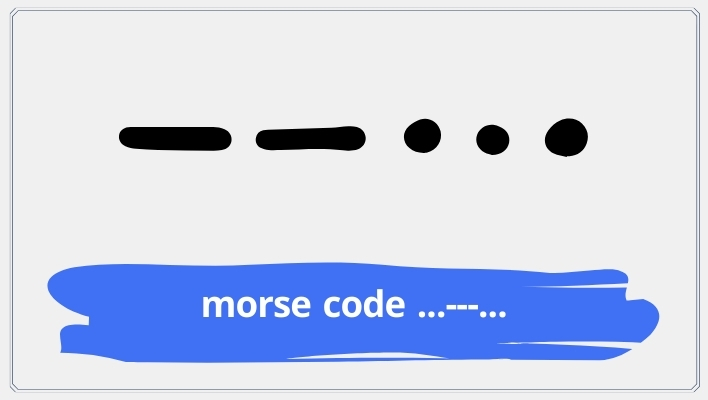
The universal distress signal is SOS. It is transmitted as three dots, three dashes, three dots (... --- ...). Crucially, it is sent as a single continuous string of sound without the standard inter-letter spacing, making it sound like one unique character.
How do you say "Hello" in Morse code?
The word "Hello" is written as .... . .-.. .-.. ---. However, in amateur radio, the abbreviation HI (.... ..) is commonly used as a friendly greeting.
Can I learn Morse code visually or is audio better?
Audio is significantly better for practical use. Morse code is a language of rhythm. Learning visually (by looking at dots and dashes on paper) often leads to a "lookup table" mental habit that slows you down. Learning by sound (auditory) builds the reflexes needed for real-time decoding.
What are the spacing rules for accurate Morse code reading?
Accurate reading relies on the standard timing ratios:
1. Dit: 1 unit
2. Dah: 3 units
3. Space between parts of a letter: 1 unit
4. Space between letters: 3 units
5. Space between words: 7 units