How to Learn Morse Code | A Step-by-Step Guide (2026)
Understanding the Language of Dots and Dashes (CW) Basics
Before diving into high-speed decoding, you must understand the fundamental timing that defines Morse code, often referred to in amateur radio as "CW" (Continuous Wave). It is not just a random collection of beeps; it is a rhythmic language based on precise time intervals.
The entire system relies on a single unit of time, often called a "dit." Every other signal is measured relative to this unit:
| Element | Duration | Description |
|---|---|---|
| Dit (Dot) | 1 Unit | The basic short signal. |
| Dah (Dash) | 3 Units | The long signal. It is exactly three times the length of a dit. |
| Intra-char Space | 1 Unit | The silence between dits and dahs within a single letter. |
| Inter-char Space | 3 Units | The silence between two separate letters. |
| Word Space | 7 Units | The silence between two separate words. |
The Golden Rule | The Importance of "Head Copy"
The single biggest mistake beginners make is trying to translate Morse code visually or mathematically. To master the code fast, you must adopt the "Head Copy" technique immediately. This means you hear a sound and your brain instantly recognizes the letter, without an intermediate step of counting or visualization.
Why Visual Memorization Slows You Down
If you memorize Morse code using a visual chart (e.g., seeing a picture of a dot and a dash next to the letter 'A'), your brain creates a "lookup table." When you hear the signal, your brain has to:
- Hear the sound.
- Visualize the dots and dashes.
- Look up the pattern in your mental image.
- Identify the letter.
This process is too slow for real-time communication. At speeds above 10 words per minute (WPM), this mental lookup table collapses, causing you to fail. You must bypass the visual center and connect the sound directly to the character.
Reddit Consensus | Hearing "A" Instead of "Di-Dah"
Experienced operators on communities like r/HamRadio consistently advise against counting dits and dahs. As noted in recent discussions, the most effective way is to train your auditory reflex. When you hear the sound "di-dah," your brain should not register two separate sounds; it should simply register the concept of "A."
Think of it like listening to spoken English. When you hear the word "cat," you don't break it down into "c-a-t" sounds; you just understand the meaning. Morse code mastery works exactly the same way.
Proven Methodologies for Rapid Learning
There are three primary scientific methods for learning Morse code. Combining these approaches often yields the fastest results.
The Koch Method | Building Character Proficiency
Developed by German psychologist Ludwig Koch, this method asserts that you should learn characters at full speed from day one. Instead of slowing down the dots and dashes (which distorts the rhythm), you play the characters at a target speed (e.g., 20 WPM) but only learn two characters to start.
Once you can copy those two characters with 90% accuracy, you add a third. This prevents your brain from forming bad habits associated with slow code.
The Farnsworth Method | Managing Speed and Spacing
The Farnsworth method complements Koch. It involves sending the individual characters at a high speed (e.g., 20 WPM) but inserting long pauses between them. This lowers the overall Words Per Minute to a manageable level (e.g., 5 WPM) while preserving the rhythmic integrity of the letters.
As you improve, you simply shorten the silence between letters, but the sound of the letters themselves never changes.
Morse Code Ninja Approach | Sound Patterns and 75% Thresholds
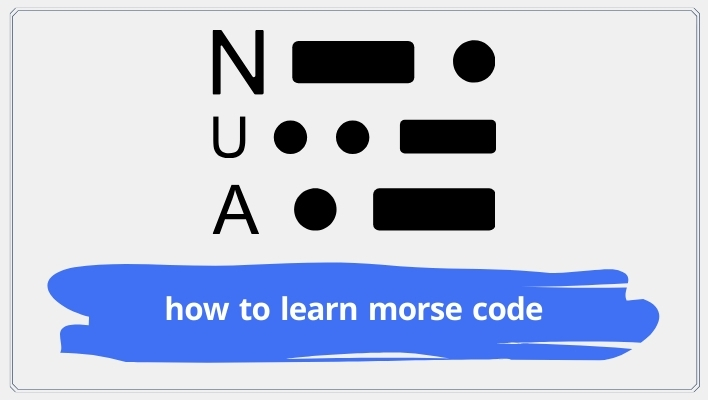
The Morse Code Ninja curriculum focuses heavily on "Instant Character Recognition" (ICR). The course is designed so students learn to distinguish between words based on their overall sound patterns rather than dissecting them letter by letter. The recommendation is to move to the next level once you reach a 75% accuracy threshold, preventing you from getting stuck on perfectionism.
Top Interactive Tools and Trainers
Modern technology has replaced old cassette tapes with interactive web apps that gamify the learning process. Here are the most effective verified tools available today.
Google's "Hello Morse" Experiment | Gamifying the Process
Developed by Google Creative Lab, this tool was designed to make learning Morse code accessible and fun. It integrates visual mnemonics with audio training, specifically optimized for mobile devices and Gboard integration.
Try it here: Google Hello Morse
Ace Centre: Accessible Training via Switch or Keyboard
The Ace Centre offers a specialized trainer that is excellent for users who may be using assistive technology, though it is equally effective for anyone. It focuses on the "Morse Learn" game which helps attach mnemonic cues to letters.
Try it here: Ace Centre Morse Trainer
Perry.qa Web App | Ad-Free Interactive Device Simulation
For a distraction-free experience, the Perry.qa web app provides a clean interface that simulates a Morse code device. It is highly praised for being completely free and devoid of ads, allowing for pure focus on the rhythm and timing.
Try it here: Perry.qa Morse App
Step-by-Step Practice Routine for Beginners
To go from zero to mastery, follow this structured routine. Consistency is more important than duration; 15 minutes a day is better than 2 hours once a week.
Phase 1: Familiarization with Basic Signals and Alphabet
Start by using the Koch Method settings on a trainer like the ones listed above. Set your character speed to at least 20 WPM and your effective spacing speed to 5 or 10 WPM. Learn the first 5 characters (usually K, M, R, S, U) until you can recognize them by sound alone.
Phase 2: The Graph Paper Strategy for Decoding
A practical tip for beginners is to use graph paper while practicing reception. As you listen to a stream of code, write the letters in the grid squares. If you miss a letter, do not stop to think. Skip the square and move to the next one.
This prevents the "domino effect" where missing one character causes you to lose the next five because your brain was stuck dwelling on the mistake. When you finish, you will have a puzzle (like "Wheel of Fortune") where you can fill in the blanks from context.
Phase 3: Transcribing Children's Books and Self-Correspondence
Once you know the alphabet, you need to build word recognition. A proven technique is to take a simple children's book and translate it into Morse code (sending practice). Alternatively, write letters to yourself in Morse code and try to read them back a few days later. This forces you to process common words and sentence structures.
Frequently Asked Questions
How long does it take to learn Morse code?
For "Head Copy" proficiency at a useful speed (10-15 WPM), most students require about 2 to 3 months of daily 15-20 minute practice sessions. You can memorize the code intellectually in a few days, but building the auditory reflex takes longer.
Is it hard to learn Morse code?
It is not intellectually difficult, but it requires discipline. It is a skill similar to learning a musical instrument or typing; it relies on muscle memory and auditory conditioning rather than raw intelligence.
What is the best way to memorize Morse code?
The best way is by sound (auditory), not by sight. Avoid charts that show dots and dashes. Use apps or audio files that play the sound of the letter so you associate the rhythm directly with the character.
Can I teach myself Morse code?
Yes, the vast majority of modern operators are self-taught using apps, websites, and software like the ones mentioned in this article. You do not need a formal instructor, though joining a club (like the Long Island CW Club) can provide motivation.
Is Morse code still useful today?
Absolutely. It is widely used in Amateur Radio (Ham Radio) for long-distance communication because CW signals can get through static and weak conditions where voice fails. It is also used in aviation navigation (VOR identification) and assistive technology for people with limited mobility.
What is the SOS signal in Morse code?
The universal distress signal, SOS, is represented by three dots, three dashes, and three dots (... --- ...). It is sent as a continuous stream of sound without the standard spacing between letters to ensure it is recognized instantly.
Is Morse code the same in all languages?
International Morse Code is the standard for the 26-letter Latin alphabet. However, other languages with different scripts, such as Russian (Cyrillic), Arabic, and Chinese, have their own specific Morse code extensions to cover their unique characters.