No in Morse Code | Translation, Symbols & Timing (-. ---)
The Quick Answer | Representing "No" in Morse Code
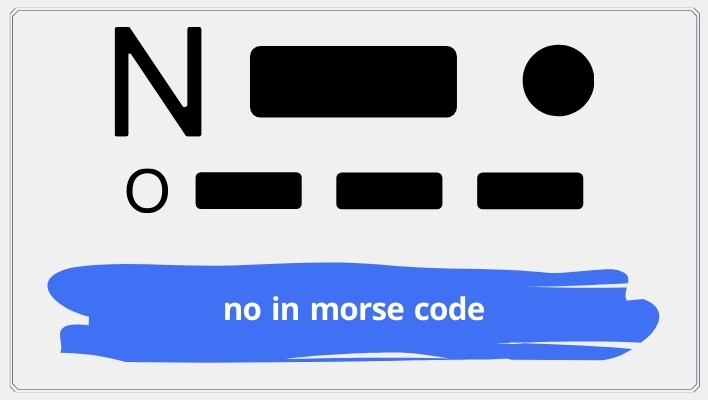
To say the word "No" in International Morse Code, you transmit the letter N followed by the letter O.
Visual Representation of NO (-. ---)
The visual pattern for "No" consists of a dash and a dot for the first letter, followed by three dashes for the second letter.
-. ---
Audio Pattern and Rhythm
In Morse code, the timing is based on "dits" (dots) and "dahs" (dashes). A "dah" is three times as long as a "dit."
- N (-.): Dah-dit (Long-Short)
- O (---): Dah-dah-dah (Long-Long-Long)
When combined to say "No," the rhythm sounds like : Dah-dit ... Dah-dah-dah.
Breaking Down the Components: Letters N and O
Understanding the individual components ensures your signal is clear and follows the standards set by the International Telecommunication Union (ITU).
The Letter N | Dash-Dot (-.)
The letter N is formed by one long signal followed immediately by one short signal.
- Symbol: -.
- Sound: Dah-dit
- Mnemonic: "Na-vy" (The first syllable is stressed/long, the second is short).
The Letter O | Dash-Dash-Dash (---)
The letter O is one of the most distinct letters in Morse code, consisting of three continuous long signals.
- Symbol: ---
- Sound: Dah-dah-dah
- Mnemonic: "O-ver-load" (Three stressed syllables).
Spacing Rules Between Letters N and O
Proper spacing is critical for legibility. Without correct pauses, "No" (-. ---) could be confused with other letters like "K" (-.-) if jammed together.
| Spacing Type | Duration Rule | Application for "NO" |
|---|---|---|
| Intra-character | 1 dot length | Space between the dash and dot of N. |
| Inter-character | 3 dot lengths | The silence between the letter N and the letter O. |
| Inter-word | 7 dot lengths | The silence after "NO" before starting the next word. |
Morse Code Abbreviations for "No"
In the world of amateur radio and CW (Continuous Wave) operation, speed is essential. Operators often use standard abbreviations defined by organizations like the American Radio Relay League (ARRL).
Using the Letter "N" as a Negative Response
In casual and formal CW conversation, you do not always need to spell out "N-O." Sending the single letter N (-.) is the universal abbreviation for a negative response.
- Question: "Copy?" (Did you understand?)
- Answer: "N" (-.) (No/Negative).
Contextual Differences | Formal vs. Casual CW (Continuous Wave)
While "N" is efficient, context determines its usage:
- Casual Chat (Ragchew): Operators might spell out "NO" for emphasis or clarity.
- Contesting/DXing: The single letter "N" is strictly used to save time.
Comparing "No" vs. "Yes" in Morse Code
To effectively communicate, you must be able to distinguish a negative response from an affirmative one.
The Signal for Yes | C (-.-.) vs. NO (-. ---)
Interestingly, the standard abbreviation for "Yes" in Morse code is not the letter "Y". It is the letter C (-.-.), which stands for "Correct" or "Confirm."
- No: N (-.) or NO (-. ---)
- Yes: C (-.-.) or AFIRM
Distinctive Sound Differences to Avoid Confusion
The audio profiles of these two responses are very different to prevent misinterpretation over static-filled radio waves.
- "No" (N): Ends on a short, sharp note (Dah-dit).
- "Yes" (C): Has a rhythmic, musical lilt (Dah-dit-dah-dit).
How to Transmit "No" Using Different Methods
Morse code is versatile and can be transmitted via sound, light, or touch.
Signaling with Light (Flashlight SOS and Communication)
When using a flashlight to signal "No":
- Letter N: Hold the light on for 3 seconds (dash), off for 1 second, on for 1 second (dot).
- Pause: Keep the light off for 3 seconds (letter space).
- Letter O: Hold the light on for 3 seconds, off for 1 second, on for 3 seconds, off for 1 second, on for 3 seconds.
Tapping and Sound Transmission
If you are tapping on a wall or table:
- Dash: A firm tap or knock that you hold slightly or a scratch sound.
- Dot: A quick, sharp tap.
- "No": Knock(hold)-Tap ... Knock(hold)-Knock(hold)-Knock(hold).
Frequently Asked Questions
What is the Morse code pattern for the word No?
The pattern for the word "No" is -. ---. It combines the letter N (Dash-Dot) and the letter O (Dash-Dash-Dash).
Can I just use the letter N for No in Morse code?
Yes, in amateur radio (CW) and telegraphy, transmitting the single letter N (-.) is the standard abbreviation for "No" or "Negative."
How do you say "Yes" in Morse code?
While you can spell out "YES" (-.-- . ...), the standard abbreviation in amateur radio is the letter C (-.-.), which stands for "Correct."
How do you distinguish between N and No in transmission?
Context is key. If "N" is sent in response to a question, it means "No." If "N" is sent as part of a word (like "Night"), it is just a letter. If the operator intends to be emphatic, they will spell out "NO" (-. ---).
How do you signal "No" with a flashlight?
To signal "No" with a light, flash one long burst (3 seconds) followed by one short burst (1 second) to represent the letter N (-.). For the full word "NO," follow this with three long bursts for the letter O.
Is there a specific Prosign for negation?
While there isn't a single "prosign" (a combined character) for "No," the letter N serves this function. However, the prosign EEEEEEEE (8 dots) is often used to signal an error or "erase" the previous mistake, which is a form of negation regarding the transmission itself.